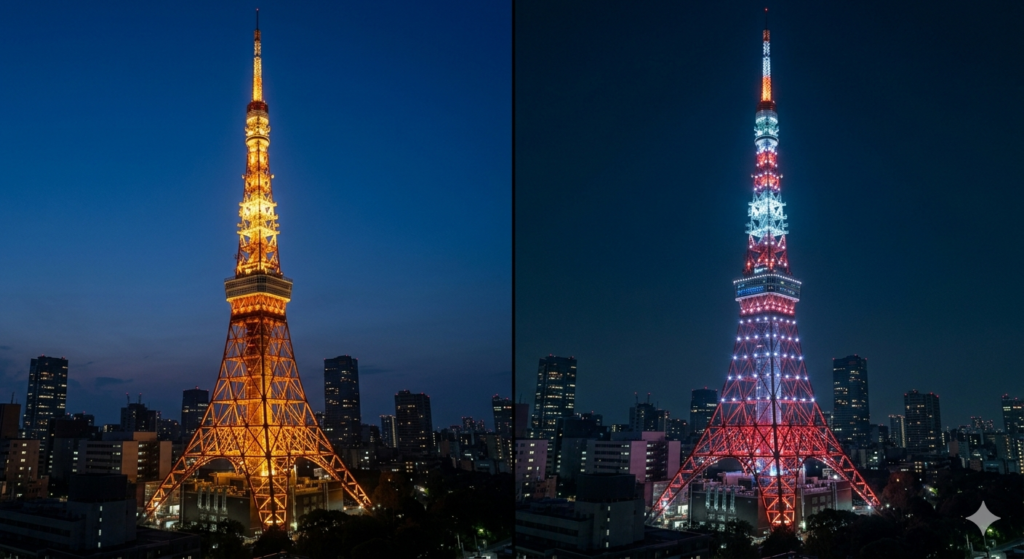
For most travelers visiting Japan’s bustling capital, Tokyo Tower is a staple on the “must-see” list. It’s an iconic landmark, a scarlet and white needle piercing the Tokyo skyline. But when visitors see it for the first time, the reaction is almost universal: “Oh, it looks just like the Eiffel Tower.”
This observation isn’t technically wrong. The tower’s designer, Tachū Naitō, based his blueprints for the 1958 structure on the Parisian original. But if you only see it as a copy, you miss the profound role this structure plays in the heart of modern Japan. To a Japanese person, Tokyo Tower is not about Paris; it is a monument to the nation’s extraordinary resilience.
The Cultural and Historical Context: A Monument to Post-War Rebirth
In 1945, at the end of World War II, Tokyo was largely a sea of ash. The nation’s infrastructure and spirit were devastated. Just 13 years later, in 1958, Tokyo Tower was completed.
This timeline is the key to understanding its true meaning. The 1950s were defined by Japan’s “Economic Miracle,” a period of explosive growth and rebuilding. The primary, functional reason for the tower was to serve as a singular, powerful broadcasting antenna for the new television and radio stations that were popping up, unifying the airwaves of the expanding city.
But its symbolic purpose was equally critical. Built just four years before Japan hosted the 1964 Tokyo Olympics, the tower served as a beacon of modernity, proving to the world (and to the Japanese people themselves) that the nation had not just survived, but was rapidly revitalizing. Its completion demonstrated that Japan was ready to reclaim its place on the global technological stage. While it has since been “retired” from its primary broadcasting duties by the taller Tokyo Skytree, Tokyo Tower’s cultural weight remains, representing the collective grit of the post-war generation.
Spotting it in the Wild: Look Closely at the Metal and the Lighting
Knowing this history transforms how you look at the structure. Don’t just stand in Shiba Park and take a quick selfie. Instead, turn your visit into a scavenger hunt for historical and cultural markers:
- The War-Torn Metal: Look up at the steel lattice. This massive structure required a tremendous amount of materials that post-war Japan was short on. To build it, they repurposed scrap metal, including tanks damaged during the Korean War. The very frame of the tower is literally built from the tools of war repurposed for peace and communication.
- The Signature “International Orange”: The tower’s striking color isn’t just a stylistic choice. It’s a pragmatic one. In order to comply with international aviation safety regulations, the structure had to be painted in alternating bands of white and “International Orange” (not red!).
- The “Landmark Light”: Pay close attention to how the tower is lit at night. On a standard night, you will see it in its “Landmark Light,” an warm, amber glow that Japanese people find nostalgic and comforting. This contrasts with the special “Diamond Veil” lighting used on holidays and weekends, which features a rainbow of colors. The Landmark Light is the default because it connects the current generation back to that 1950s spirit.
Language and Etiquette: Showing Respect in the Heart of the City
When you approach the tower through the adjacent Shiba Park or explore the temples nearby, you are in a revered space. A little language knowledge can deepen your respect for the environment.
Why it’s difficult:
Standard Japanese polite phrases are necessary, but the context here is specific. You aren’t just a customer; you are in a location that serves as the “backyard” for locals and spiritual practitioners. Using polite language isn’t just about getting service; it’s about acknowledging the shared space respectfully.
Breakdown of a phrase: “O-saki ni dōzo”
When you are about to step onto the elevator, navigate a crowded view deck, or find yourself merging with locals on a path in the park, this phrase is incredibly valuable.
- お先に (O-saki ni): This combines the polite prefix “O” with “saki ni,” which means “before” or “first.”
- どうぞ (Dōzo): A versatile word that can mean “please” or “go ahead.”
Together, “O-saki ni dōzo” means “After you,” or “Please, go ahead.” It’s a simple act of deference that goes a long way in Japanese culture, showing you are aware of others and not just pushing forward.
The Local Insight: A Living Museum, Not Just a Tourist Spot
While you will see fellow travelers everywhere, remember that Tokyo Tower is deeply integrated into local life. It’s not just an artifact; it’s part of the landscape of Tokyo’s businesses, romances, and quiet moments.
How to see it like a local: Rather than just going to the top (though the view is excellent), spend some time on the ground level in Shiba Park, especially at dusk. You will see office workers (salarymen and OLs) taking a moment to decompress after work, friends sharing a bento box, or couples strolling under the amber “Landmark Light.” This is when you see the tower doing its real modern-day job: acting as a comforting, unchanging presence in a city that is always evolving.